
Services
Our VR services revolutionize how organizations learn, collaborate, and grow—creating unforgettable experiences that inspire action and accelerate success.
Our main services
VerseTech offers an integrated system of immersive technological solutions specifically designed to meet the needs of the academic, medical, and industrial sectors. Our four services are integrated to form a comprehensive digital environment that covers various aspects of digital transformation.
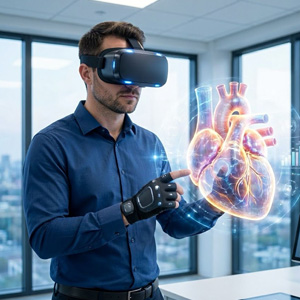
Virtual medical simulation
Developing Medical VR Simulations provides safe and high-fidelity training environments for medical personnel, enabling doctors, nurses, and technicians to practice complex surgical and diagnostic procedures without exposing patients to any risks.
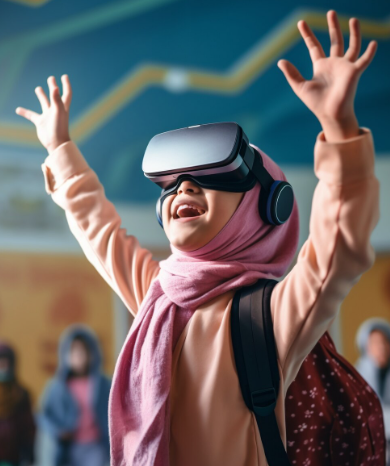
Interactive Educational Solutions
VerseTech Solutions transforms academic curricula into interactive augmented reality AR experiences that make learning more engaging and effective, helping students grasp complex concepts through direct experience rather than rote memorization.
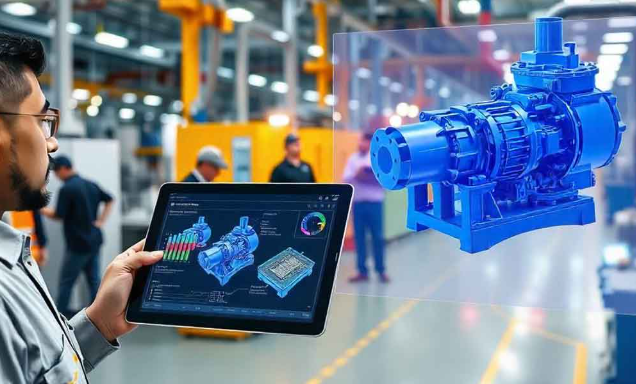
Digital Twins
Building virtual models of digital twins that replicate laboratories, medical facilities, and technology, enabling smarter management, predictive maintenance, and training in real-world environments without the need for physical presence.
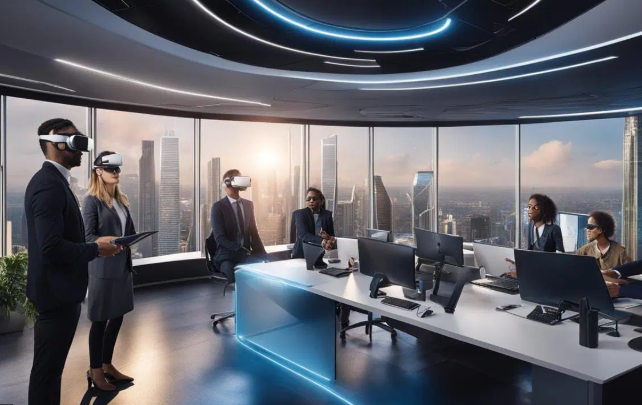
Metaverse Platforms for Business
Metaverse Platforms designs professional virtual spaces for meetings, exhibitions, and international conferences, enabling organizations to host high-quality business events at lower costs with wider reach.
The key differences between Virtual Reality (VR), Augmented Reality (AR), and the Metaverse.
| Feature | VR | AR | Metaverse |
|---|---|---|---|
|
Core Definition |
A fully immersive digital environment that replaces the real world. |
Overlays digital content onto the real-world environment. |
A persistent, shared, 3D virtual space where physical and digital realities converge. |
|
Primary Device |
Head-mounted display (e.g., Meta Quest, HTC Vive, PlayStation VR). |
Smartphone, tablet, or AR glasses (e.g., Microsoft HoloLens, Magic Leap). |
VR/AR headsets, computers, phones, or any internet-connected device. |
|
User Experience |
Complete sensory immersion (sight/sound, often haptics). User is “inside” a simulated world. |
Real-world view enhanced with text, images, or 3D objects. User remains aware of surroundings. |
Persistent identity, social interaction, economy, and interoperability across platforms. |
|
Environment |
Fully digital, closed environment (can be solo or multiplayer). |
Mixed environment: real world + digital overlays. |
Interconnected digital worlds that exist continuously, even when user logs off. |
|
Interactivity |
High—users interact with purely digital objects and avatars. |
Medium—users interact with digital objects anchored to real-world spaces. |
High—social, economic, creative, and cross-platform interactions with persistence. |
|
Examples |
Beat Saber, Half-Life: Alyx, virtual training simulators. |
Pokémon GO, IKEA Place app, Snapchat filters, Google Maps Live View. |
Fortnite (live events), Decentraland, Roblox, VRChat, Somnium Space. |
|
Persistence |
No (world resets or ends when session ends). |
No (overlays disappear when device is off). |
Yes (world continues to evolve regardless of user presence). |
|
Connection to Real World |
No (real world is blocked out). |
Yes (enhances real world). |
Partial (digital twin elements can mirror or influence real world). |
|
Key Technology |
Head tracking, stereoscopic displays, controllers. |
SLAM (Simultaneous Localization and Mapping), image recognition, GPS. |
Blockchain (sometimes), VR/AR, cloud computing, digital avatars, user-generated content. |
Key Takeaway:
- VR is about immersion (replacing reality).
- AR is about enhancement (adding to reality).
- Metaverse is about persistent, interconnected digital life (a universe of many virtual spaces and activities, often accessed via VR/AR).
Key benefits of (VR) & (AR)
Immersive learning environments that improve knowledge retention
Safe, repeatable practice for high-risk professions (surgery, aviation, hazardous materials)
Virtual field trips and historical recreations without travel costs
Pain distraction therapy and anxiety reduction during procedures
Exposure therapy for PTSD and phobias in controlled settings
Remote rehabilitation and physical therapy monitoring
Virtual meeting spaces that reduce travel expenses and carbon footprint
Remote site inspections and real estate walkthroughs
Prototyping and design review before physical production
Experiences impossible in physical reality (space travel, deep sea, fantasy worlds)
Accessible tourism for those with mobility limitations
Interactive storytelling and gaming with full body presence
Accessibility (experiences for people with disabilities)
Cost reduction (travel, materials, physical prototypes)
Safety (dangerous scenario training without real risk)
Virtual reality and augmented reality are not just about seeing another world, but about seeing our own world with new insight and possibility — transforming how we learn, heal, and connect.
Rony Abovitz
entrepreneur and founder of Magic Leap, a pioneering AR company